⏳ LAUNCH PRICING ENDS IN

00
HRS
00
MIN
00
SEC

- UP TO 67% OFF + FREE SHIPPING

⏳ LAUNCH PRICING ENDS IN

00
HRS
00
MIN
00
SEC

— UP TO 67% OFF + FREE SHIPPING

7 Reasons Your Cat Is Fading, Losing Muscle, and Aging Faster Than She Should

— And the Nutrition Gap Most Owners Never Hear About

By Dr. Rachel Nguyen, DVM · Reviewed July 2026 · 5 min read

Before you write it off as "just getting older": veterinary researchers identified a direct link between taurine deficiency and serious heart disease in cats back in 1987. Since then, most commercial cat foods have added taurine — but the amount that actually survives processing and reaches your cat's heart is a very different number from what's printed on the bag. Here are 7 warning signs worth paying attention to, and the simple daily habit thousands of cat owners have added to get ahead of it.

1. "She's Just Getting Old" Is the Most Dangerous Assumption You Can Make

Your cat used to greet you at the door. She'd chase a crinkle ball across the room. She'd leap onto the counter before you could blink.
 

Now she lifts her head from the couch and goes back to sleep.
 

You told yourself it's age. Your vet probably agreed. But here's the uncomfortable truth: slowing down, sleeping more, and losing interest in play are also the early signs of a heart and muscles that aren't getting the fuel they need.
 

By the time "she's just old" becomes obvious, the underlying gap has usually been building for months — silently, invisibly, while you assumed everything was fine.
 

Age is a story we tell ourselves. It isn't a diagnosis.

2. Your Cat's "Complete" Food May Be Failing Her — Quietly

You buy the good stuff. Maybe you even switched to grain-free or premium wet food because someone said it was better. You read the label. It says "complete and balanced." It lists taurine.
 

But here's what the label doesn't tell you: "complete and balanced" is measured in a lab, before the food is cooked.
 

Taurine is fragile. It's water-soluble and heat-sensitive. High-heat processing — the kind that makes kibble shelf-stable for months — degrades taurine before the bag is ever sealed. Research has shown that heat-processed diets cause substantially greater taurine losses than raw or frozen diets.
 

So the number on the label and the amount that actually reaches your cat's heart? Those are two very different things. Nobody at the pet store is going to explain this to you.

3. Your Cat Can't Make Her Own Taurine — She's Completely Dependent on You

Dogs can synthesize some taurine on their own. Cats cannot. Not even a little.
 

Cats are obligate carnivores. Their bodies evolved to get taurine from raw meat — not from a processed kibble that's been cooked at over 200 degrees and stored on a shelf for six months.
 

This means every single cat — regardless of breed, age, or diet — is entirely dependent on what you put in her bowl. If the taurine in her food doesn't survive processing, she has no backup plan. Her body can't manufacture what's missing.
 

That's a vulnerability most cat owners have never been told about.

4. The Signs Are Subtle — Until They Aren't

Cats are masters at hiding decline. By the time you notice something's wrong, it's usually been building for weeks or months. Here's what to watch for:

  • Sleeping noticeably more than usual
  • No longer jumping onto furniture she used to reach easily
  • Loss of muscle along the spine and hips — you can feel her bones
  • Dull, unkempt coat she's stopped grooming properly
  • Less interest in play, toys, or interaction
  • Eating normally but still losing weight

Any one of these is easy to dismiss. Together, they paint a picture of a body that isn't getting the fuel it needs to maintain itself. And most owners don't connect the dots until it's advanced.

5. Plain Taurine Alone Only Does One-Third of the Job

Say you've already heard about taurine. Maybe you even bought a plain taurine powder and started sprinkling it on her food. Good instinct.
 

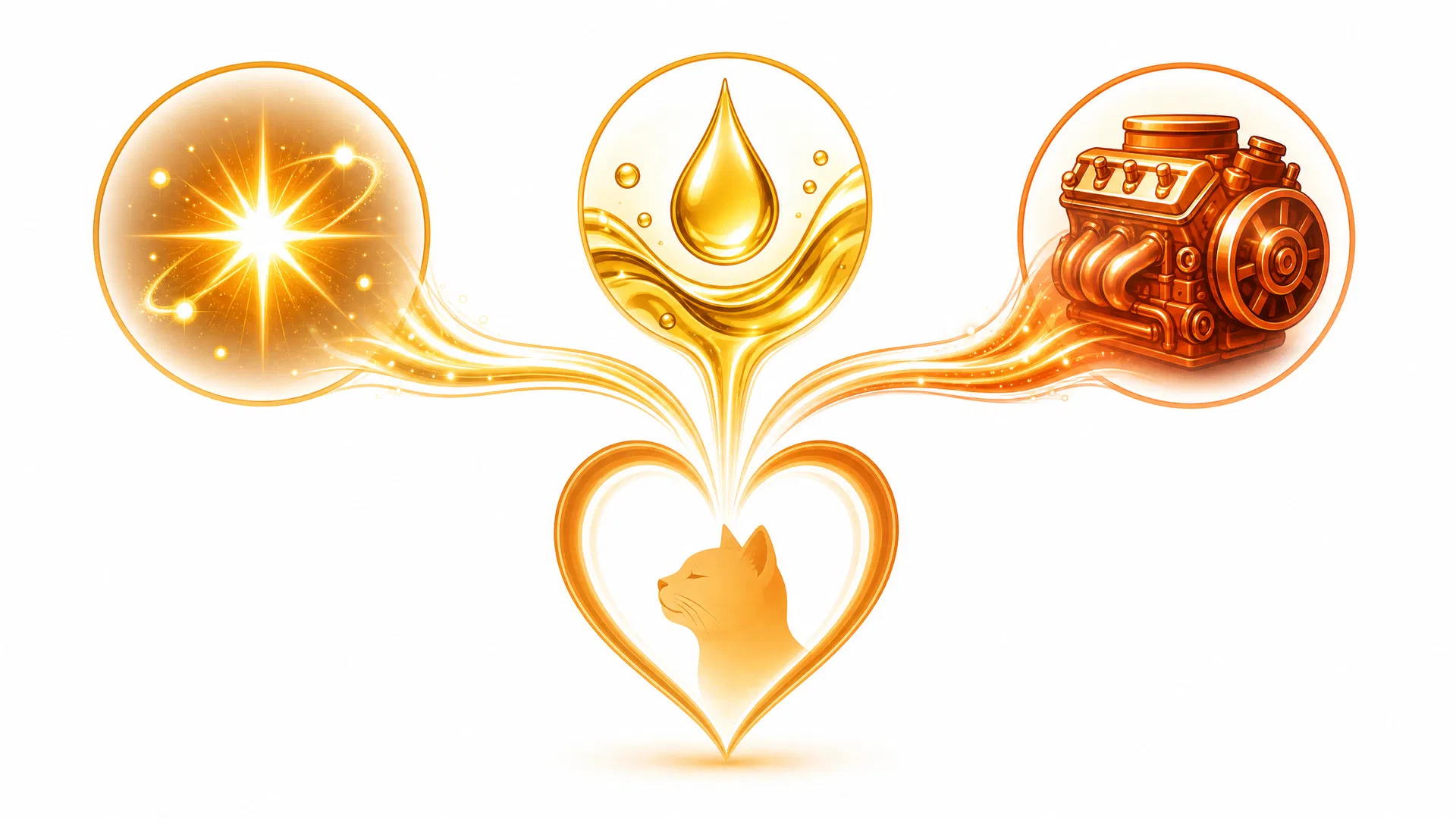
But here's what most supplement brands won't tell you: taurine is only the spark. It signals the heart muscle to contract. That's critical — but a working heart also needs fuel to burn, and an engine to burn it.
 

Plain taurine gives your cat one piece of a three-piece puzzle. It's like putting a fresh spark plug in a car with no fuel in the tank. The spark fires, but nothing moves.

Whole-Cat adds all three:

1

Taurine (never-cooked, protected from heat degradation)

The spark — signals the heart to contract

2

L-Carnitine (carries fatty acids into cells for energy)

The fuel — delivers energy to the heart muscle

3

CoQ10 (powers the mitochondrial engine)

The engine — converts fuel into usable energy

6. Heart Problems in Cats Stay Silent Until They're Serious

The condition that first put taurine on the map is dilated cardiomyopathy (DCM) — the heart muscle weakens and enlarges, pumping less blood with each beat. In cats, it often shows no visible symptoms until it's advanced.
 

By the time a cat is breathing heavily, tiring quickly, or collapsing, the damage may be well along.
 

The encouraging flip side: when the issue is nutrition-related and caught early, many cats improve once the gap is corrected. Researchers documented a 58% one-year survival rate in cats with DCM who received taurine supplementation — a marked improvement over untreated cats.
 

Which is the entire point of getting ahead of it. Not reacting after. Getting ahead of it now.

7. The Cost of Adding Full Support Is Tiny. The Cost of Waiting Isn't.

Taurine is water-soluble — cats excrete what they don't use, which is why it's well tolerated as a daily supplement at sensible doses. Add the two energy co-factors and you've built a daily margin of safety into your cat's bowl for about the price of a coffee a week.
 

One scoop, stirred into any food, completely tasteless — even the pickiest cats won't notice it.
 

On one side of the scale: a few seconds a day. On the other: the one outcome every cat owner is desperate to avoid. You get to decide which side you'd rather be on — today, while it's still your choice.

What Cat Owners Are Saying

"I was twelve hours from putting her down. I wish someone had told me sooner."

"My 13-year-old had been declining for months. Losing weight, spine showing, barely moving. The vet said it might be time. The night before the appointment, I found Whole-Cat. I gave it two weeks. She started eating with energy again, gained weight, and now she jumps on the counter like she's five. I'm still angry nobody mentioned the taurine gap earlier."

— Sarah M., Austin, TX · Verified Buyer

"I wasn't watching her get old. I was watching her food fail her."

"Within a month my 9-year-old was playing with toys she'd ignored for over a year. More energy, brighter coat, actually grooming herself again. She wasn't old — her diet had been leaving her short the whole time, and no one had ever explained why."

— Jennifer K., Portland, OR · Verified Buyer

"Bought it on the guarantee. Stayed because it actually worked."

"I'd already tried plain taurine for six months with zero change. Switched to Whole-Cat because of the money-back guarantee — figured I had nothing to lose. Three weeks in, my cat was meeting me at the door again. The difference between one ingredient and all three is night and day."

— Rachel D., Denver, CO · Verified Buyer

YOUR VET WON'T TELL YOU. WE JUST DID.

Decades of published research. Three active ingredients working together. One tasteless scoop a day. Up to 67% off for a limited time.

GET WHOLE-CAT NOW →

Sell-Out Risk: High

FREE US Shipping

Try it risk-free with a 60-Day Money-Back Guarantee

Title

CATLYST
© 2026 Catlyst · getcatlyst.com

These statements have not been evaluated by the FDA. Whole-Cat is intended to support normal heart function and everyday energy in cats. It is not intended to diagnose, treat, cure, or prevent any disease, including DCM. Taurine deficiency as a cause of feline DCM was identified in 1987; since then, commercial cat foods have been fortified, but individual absorption varies. This product is a structure/function supplement and is not a substitute for veterinary care. Consult your veterinarian if your cat has a medical condition. Individual results may vary. Testimonials reflect individual experiences.